Scales Of Malice

Posted in Ethics & Morality, Philosophy on April 5th, 2009

That we as members of a society must judge the actions of others is a fact. While there is no need – beyond the pragmatic or utilitarian level – to “pass judgment” upon a person or his actions, we must judge the import of those actions and frame them in the context of their intent and within the framework of the other person’s goals in order to predict future behaviors and their possible effect upon us.

The question arise though – how do we judge another’s intent and goals? What scales do you use to derive our measurements? Do we weigh the actions of others on our own scales of malice, or do we weigh them on what we can perceive of their scales of malice?

For he is very wise, and weighs all things to a nicety in the scales of this malice. But the only measure that he knows is desire, desire for power; and so he judges all hearts. Into his heart the thought will not enter that any will refuse it.

– Gandalf
J.R.R. Tolkien’s The Fellowship of the Ring, p. 203

It a common thought that we judge others by own desires and from solely within our own framework of goals and perceptions – or at least it’s a common rebuttal in many arguments. Somehow I doubt this assertion is anywhere near universal in its accuracy.

I think it is important for people to determine by which and whose scales they judge the actions and malice of others though.

Our Scales:

If we are judging the actions of others based upon what we would do in a similar circumstance, then our judgment is bound to be very subjective. It also would, at that point, say as much or more about ourselves as it does about the object of our judgment.

It would also be a flawed basis for judgment in many cases. People are not all the same and – beyond the primal needs – do not necessarily have similar motivations. By judging others only by own goals we leave ourselves open to being outmaneuvered by our enemies, as the quoted passage above asserts.

Still, it’s a consistent framework for judgment and one that can be rapidly brought to bear on a situation. Therefor it is not wholly lacking in merit – if one accepts its limitations and plans accordingly.

Their Scales:

If we are judging the actions others based upon their own goals and capabilities, then our judgment is not going to be subjective in the same manner as if we judged based on what we would do in the same or similar circumstances. The subjectivity would be more a case of targeting the assessment to the situation and individuals or groups involved.

It would also be a basis of judgment that has to be predicated on either prior knowledge of the individuals or groups involved or a high degree of empathy. Lacking a sufficient amount of either would render judgment based upon their intent, goals, capabilities flawed to the point of uselessness.

Still, it has the capacity for greater accuracy than basing one’s judgment on ones’ own intent, goals, capabilities. Therefor it is not wholly lacking in merit – if one accepts its limitations and plans accordingly.

It is certainly beyond me to determine which framework of judgment is better in the long run; I’m not even sure if either one is better than the other in an overall manner. Both scales of malice, internal and external, have the strengths and weaknesses.

It is not beyond my capabilities though to conclude that it is best to know, or at least consider, by which one – or at what level of combination – one is assessing the ramifications and intent of others’ actions in any given situation.

[Slashdot] [Digg] [Reddit] [del.icio.us] [Facebook] [Technorati] [Google] [StumbleUpon] [Twitter]

A Sick Society

Posted in Ethics & Morality, Society on December 13th, 2007

I came across this post on WordPress’ Tag Surfer and it really set me off on a rant. The blog’s owner apparently dislikes dissenting opinions and deleted my comment, so I’ll quote him verbatim below and add my commentary.

Mental Illness in America II

December 14, 2007 by nightbird16

Just a week ago, Richard Dawkins, a distraught and mentally ill teenager in Colorado, shot eight shoppers. Sunday morning, another young mentally disturbed young man, Matthew Murrey’, shot five members of a missionary training center and church, also in Colorado. Although a few years older than Richard, Matthew exhibited the same symptoms of an isolated, depressed and failure-plagued young person: relationship problems with parental figures, isolated from possible friends his own age, feeling a failure and abused, and at last hearing voices in his mind, he struck out at a christian community he felt had rejected and let him down.

His parents chose to take him out of the public school to home school him in a strict Christian fashion, which he resented because it deprived him of opportunities to make friends. He felt unable to “live up to the strict behaviorial standards set for him by his parents and fundamentalist theology and that plunged him into a deep and suicidal depression. His parents put him on medication to control the depression, but that apparently didn’t help. He sought aid from church and missionaries, and they too failed to heal his panic and suffering.

Finally, he armed himself with an assault rifle, handguns and 1000 rounds of ammunition and went to take revenge on a Christian community which he could not join and could not escape.

Guns and mental illness is a fatal combination, but parents and church must share responsibility for what happened. Without support and effective counseling, many teens fall by the wayside in America. And the story looks dreadfully similar: isolation, failure, unrelenting pressure and control leads to tragedy again and again. When something goes wrong, parents blame “the wrong crowd.” The church blames evil values. Politicians blame evil children.

I blame a sick society that devours its own children.

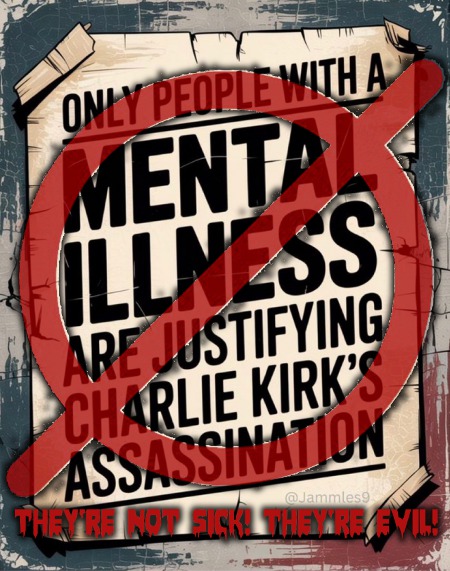
Yes, Nightbird16, America suffers from a sick society. That sickness is manifest in the people that put on their oh-so-comfortable blinders and claim any sort of evil or selfishness as an illness. Evil exists! Selfishness, Evil’s bastard spawn exists! They don’t magically go away because people mislabel them as some sort of illness, or blame them on society.

Dawkins and Murrey were a pair of selfish, self-centered losers who wanted to die in a blaze of fame and supposed “glory” – nothing more. They weren’t mentally ill; they were evil, selfish and useless. Do their parents share the blame for that? Yes, they raised a pair of misborn freaks who turned to evil. Does society share them for that? Only insofar as it doesn’t have an effective means of culling such human trash before they can harm others.

It’s is decades past time for America to start forcing people to be responsible for their own choices and their own actions. It is decades past time to stop excusing the criminal and evil behavior of individuals because we’re too cowardly to look evil in the face and pull the trigger.

I blame it on a sick society who’s too afraid to face evil.

[Slashdot] [Digg] [Reddit] [del.icio.us] [Facebook] [Technorati] [Google] [StumbleUpon] [Twitter]