 jonolan on Disney’s Indy Moments: “True! Though I don’t really understand why. They’re ruining their brand and their bottom line.” Aug 30, 07:36


A Democrat Big Lie
Posted in Books & Reading, Politics, Society on June 4th, 2024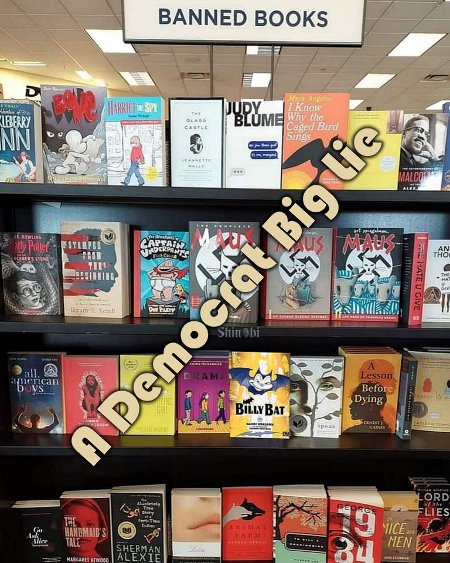
Democrats love their Big Lies, mostly because their entire political platform is founded upon them and the supposed correction of them. But, for this post, I’m going to focus upon the Big Lie of “Banned Books.”
Simply put, barring a very, very few exceptions based upon the content being ruled as fraudulent (The Federal Mafia) or being classified material (Operation Dark Heart), there are no legally banned books in America and haven’t been since the 1971 SCOTUS decision in New York Times Co. v. United States. In point of legal fact, most previously banned books were made available for general publication after 1959, when the SCOTUS in Kingsley Pictures Corp. v. Regents overturned the Federal Anti-Obscenity Act (Comstock Act) of 1873.
No, almost the entire extent of “book banning” in the US is limited to concerned individuals wanting to protect children by keeping certain sorts of reading materials out of our schools. And, this is something that both Americans and Democrats have regularly engaged in for many decades and for fundamentally the same reason – protecting impressionable children from materials that they deem to be damaging to their psyches. It must be said though that Democrats are more likely to remove material from school libraries because of the author rather than the content than Americans are, e.g., many works by Dr. Seuss – even beyond the limited set of his works that could be – in a few cases, quite easily – considered to be “racially insensitive.”
And please, do not be like the Dems and their media and equate challenging a book with successfully banning it. Among both Americans and Democrats there always has been, are, and always will be a minority that challenges the publication and dissemination of various and sundry works. They fail and, even when they seem to succeed at the local level, our court system as quickly as the wheels of law allow reverses that success due to the 1st Amendment.
So, Book Bans are just another Democrat Big Lie.
A Couple Of Additional, Personal Points
I’m just going to add a few bits of my personal opinions on related points to the core of this post, mostly because I don’t feel like doing follow-up posts to cover these tangential specifics.
Ratings & Grade Scales
In my opinion, America needs to “rate” some of these books for age appropriate content. What I’m OK with in elementary school is far more limited than what I’m OK with in middle schools. And, when it comes to high schools, there’s very little in the way of reading materials that I believe should be restricted. Blanket restrictions across all grades, just like blanket approvals, don’t make a lick of sense to me.
Parental Approval
While I’m all for opt-outs and requiring parental approvals, I can’t see how this would be effectively applied to books in school libraries. If the books can be checked out by any kid, they’ll be passed around if their made “forbidden.” All requiring parental approval would do in my opinion is create “cool kids” who got to read these and pass them around for social credit or actual monetary / material profit. The Penthouse magazines that somebody – 😉 – passed around my high school being a possibly extreme example of this.
To Kill A Mockingbird – WTF!
Just as a quick WTF sidenote, Democrats seem to hate and have tried to remove Harper Lee’s To Kill A Mocking Bird from some of their school districts, but Americans have never seemed to have a problem with it.
You’d think, given the anti-American propaganda of the ever-so-woke Left, that it’d be either the other way around or with the Democrats also having no problem with it. Harper Lee’s Pulitzer Prize-winning 1960 novel does, after all, show stereotypical racism from Whites and fits near perfectly with the Democrats’ CRT curricula, since it showed what amounted to systemic racism and a lynch mob mentality. But no; they hate it because of problematical language and racial – that’d be towards Blacks – insensitivity.
Catcher In The Rye
I don’t believe that J. D. Salinger’s 1951 work, Catcher In The Rye should be banned from high schools. I do, however, think it should be removed from all required reading lists and school curricula. I would like to think that that book is despised by both Americans and Democrats as being harmful to minds of teenagers. In fact, I’m pretty sure that having to read and study it has tipped at least one at-risk teenager into serious depression.

 And, Folks! We’ve been


