The rays from this beacon, lighting this gateway to the continent, will welcome the poor and the persecuted with the hope and promise of homes and citizenship. It will teach them that there is room and brotherhood for all who will support our institutions and aid in our development; but that those who come to disturb our peace and dethrone our laws are aliens and enemies forever.
— Chauncey Depew
Recent Comments
jonolan on Disney’s Indy Moments: “True! Though I don’t really understand why. They’re ruining their brand and their bottom line.” Aug 30, 07:36
typing learn on Trump Won: “getting the popular vote too is a massive shift.” Aug 26, 15:09
robber run on A Fine Irish Meal: “if the potatoes aren’t cooked three different ways then what’s the point” Aug 24, 22:17
Mikko Rantalainen on A Monument To Gen Z: “The official name of this artwork is “Journey of Self Discovery” but I agree that “Monument to the new generation”…” Jul 2, 07:45
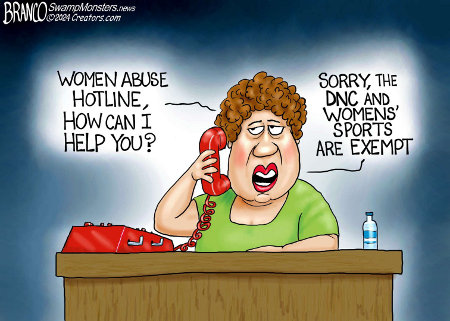
You would think that a large portion of the Feminists would be turning against the Democrats, given how that political organization has been treating them over the last few years.
Womyn For Democrats
Confusingly and sadly – more the latter, because it makes sense if you account for selfishness and evil – these womyn will put up with any abuse from the Dems as long as they can kill their unborn children at will, for any any reason or no reason at all.
This entry was posted on Wednesday, September 4th, 2024 at 9:27 am and is filed under Politics, Society.
You can skip to the end and leave a response. Pinging is currently not allowed.
Every American of conscience should always remember that it is the same things that won’t call an unborn baby a baby that demand that we call Adm. Richard Levine a woman. Then, this is what happens when things’ only acceptable science is political science.
So yes, Ladies and Gentlemen of America, it’s the same things, the same problems, and the same threat to our nation’s future. And there’s a singular, effective, permanent solution for the question they represent. We only have to put aside our squeamishness and comfort in order to enact it.
This entry was posted on Sunday, May 5th, 2024 at 10:20 am and is filed under Politics.
You can skip to the end and leave a response. Pinging is currently not allowed.
OK. So, it’s The View‘s co-host Sunny Hostin – a rabidly White-hating Blatino – who said it. Hence, it neither too surprising nor important. Yet, this is a level of insult and disdain that is both beyond the pale and just cause for retribution.
I read a poll just yesterday that White, Republican, suburban women are now going to vote Republican.
It’s almost like roaches voting for Raid.
They’re voting against their own self-interest. Do they want to live in Gilead? Do they want to live in The Handmaid’s Tail’?
Yes, that’s right. This Trigueño scag called our women cockroaches or, at least, strongly implied the comparison, most likely in response to a recent Wall Street Journal poll that showed that White, suburban women now favor the GOP by15 percentage points, which is a hefty 26-point upswing from August. She really seems to despite the simple fact that White women, who rarely kill their unborn children, are more concerned with the economy than the SCOTUS’ decision in Dobbs.
Sunny Hostin – born Asunción Cummings – is also seemingly totally unaware of her Black heritage and the intrinsic and unavoidable link between Blacks and cockroaches in America, their both being brought to our shores from Africa. Or maybe she is aware of this and is chortling over insulting our women even worse in her mind than most realize.
But, of course, aside from some useless ire on our part, nothing will likely come of this and no acts of just reprisal will be enacted upon Hostin by either her employers – who pay her to say things like this – or the People. Hostin’s view of our wives, daughters, sisters, and mothers will stand unchallenged in any meaningful and/or lasting manner.
This entry was posted on Saturday, November 5th, 2022 at 7:38 am and is filed under 2022 Elections, Politics.
You can skip to the end and leave a response. Pinging is currently not allowed.
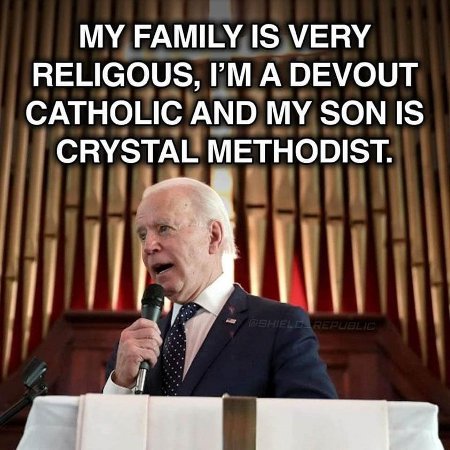
In point of fact, Hunter is a far more devout Crystal Methodist than Creepy Uncle Joe is a Catholic. Then again, Joe’s views on abortion and his apostasy may have a lot to do with Hunter’s “religious rights.” He may just not want any more of Hunter’s bastard by-blows showing up. 😉
This entry was posted on Sunday, July 17th, 2022 at 7:00 am and is filed under Humor, Politics, Religion.
You can skip to the end and leave a response. Pinging is currently not allowed.
Recently, Creepy Uncle Joe was ranting and railing to fellow Democrats a 10-year-old girl from Ohio who allegedly had to travel to a different state to get her rapist’s baby aborted.
This isn’t some imagined horror. It’s already happening. Just last week, it was reported that a 10-year-old girl was a rape victim in Ohio — 10 years old — and she was forced to have to travel out of the state, to Indiana, to seek to terminate the presnency [pregnancy] and maybe save her life. That’s — the last part is my judgment. Ten years old. Ten years old. Raped, six weeks pregnant. Already traumatized. Was forced to travel to another state. Imagine being that little girl. Just — I’m serious — just imagine being that little girl. Ten years old.
— Joe Biden
Karine Jean-Pierre, Biden’s Press Secretary, later went so far as to claim that Biden “spoke to that young woman just to show how extreme the decision on the Dobbs decision was and just how extreme it is now for American public, the American families when there is no exception at all.” Not, mind you, that anyone should have much confidence in her assertion.
Of course – and, like most things coming out of this attempt at an administration – the poor, little girl is nowhere in evidence, not even on paper. And, from what we can gather to-date, she also isn’t in any legal database despite both Ohio and Indiana being Mandatory Reporting States.
In point of fact, the only reference we have of this girl is a reporter in Indianapolis writing of an abortionist, Dr. Caitlin Bernard, in Indiana who supposedly claimed that an Ohio doctor called her hours after the Dobbs decision, claiming he had a six-weeks and three days pregnant 10 year-old and asking if she could help her.
The required confluence of implausibilities in this story are staggering, though not as staggering as the White House’s promulgation of it. A perfectly timed at three days past the de facto cut-off point under Ohio’s abortion laws pregnant preteen rape victim and no legal investigations or known reports in either Ohio or Indiana? Not likely. Not likely at all.
No, what probably happened was some Dem operative among the White House staff found the story in the IndyStar and fed it to Biden, knowing he’d get appropriately emotional over it as he read it off the teleprompter. But, in regards to Jean-Pierre’s statement, I’ve got nothing. Either she made it up out of whole cloth or was fed it by her superiors.
But then, these are Democrats, and facts aren’t what’s important to them.
This entry was posted on Wednesday, July 13th, 2022 at 11:00 am and is filed under Politics.
You can skip to the end and leave a response. Pinging is currently not allowed.
Announcement
Due to issues between the latest version of WordPress and my gallery plugin, galleries are currently broken. As a workaround, right-click gallery thumbnails and choose Open in New Tab or New Window.
 jonolan on Disney’s Indy Moments: “True! Though I don’t really understand why. They’re ruining their brand and their bottom line.” Aug 30, 07:36