A tyrant must put on the appearance of uncommon devotion to religion. Subjects are less apprehensive of illegal treatment from a ruler whom they consider god-fearing and pious. On the other hand, they do less easily move against him, believing that he has the gods on his side.
— Aristotle
Recent Comments
jonolan on Disney’s Indy Moments: “True! Though I don’t really understand why. They’re ruining their brand and their bottom line.” Aug 30, 07:36
typing learn on Trump Won: “getting the popular vote too is a massive shift.” Aug 26, 15:09
robber run on A Fine Irish Meal: “if the potatoes aren’t cooked three different ways then what’s the point” Aug 24, 22:17
Mikko Rantalainen on A Monument To Gen Z: “The official name of this artwork is “Journey of Self Discovery” but I agree that “Monument to the new generation”…” Jul 2, 07:45
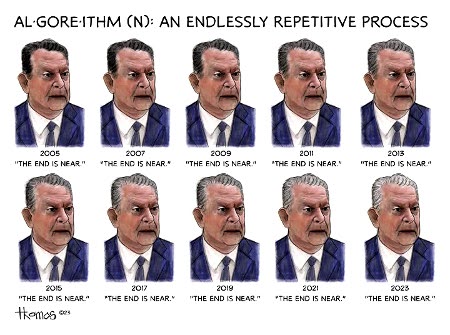
The Al·Gore ·Ithm doesn’t lie. This is a doomsday retrospective covering 20 years of Al Gore profiting from predicting the end of the world due to a multiplicity of climate disasters supposedly being brought about by the same economy that pays his way. 🙄
This entry was posted on Friday, December 12th, 2025 at 11:12 am and is filed under Humor, Politics, Society.
You can skip to the end and leave a response. Pinging is currently not allowed.
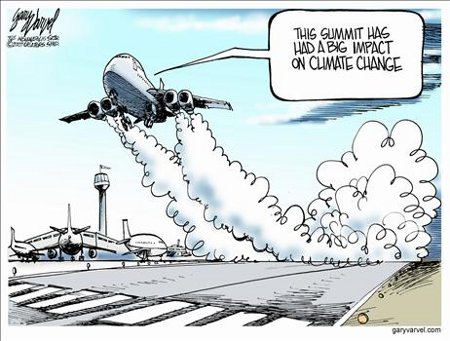
Another Climate Week NYC, the annual global climate circus and circle jerk, where up to 85,000 virtue-signaling, left-wing elites flocked to Manhattan, has recently ended… at an estimated “cost” of 120,000 tons of CO2 being added to the atmosphere – about the same as 16,000 American homes over an entire year or the annual greenhouse gas emissions from roughly 26,000 gasoline-powered passenger vehicle.
All that so that these elites could tell us normal people that we shouldn’t be eating meat or flying so often – except to climate events, apparently, that we should be forced to buy expensive electric cars, and that we must subsidize wind and solar despite our skyrocketing electricity prices. They’re even now saying that dogs are bad for the climate.
This entry was posted on Tuesday, September 30th, 2025 at 2:33 pm and is filed under Politics, Society.
You can skip to the end and leave a response. Pinging is currently not allowed.
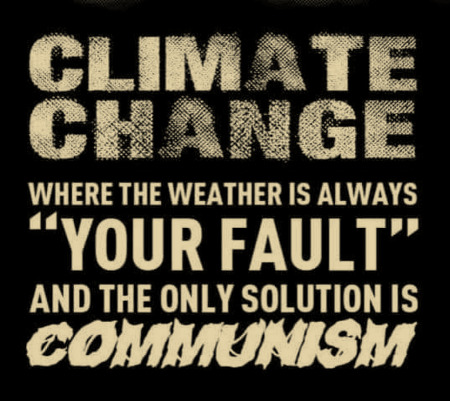
What is Climate Change? The above is Climate Change when it’s capitalized as a codified proper noun and political agenda. Oh, climate change – in the lowercase, reality-based sense – is real in that the climate changes constantly and various inputs, including human-caused ones, do have impact upon the nature of those changes. It’s just that only sciences that Climate Change is based upon is political science, sociology, and social engineering.
This entry was posted on Thursday, May 23rd, 2024 at 9:15 am and is filed under Politics, Science, Society.
You can skip to the end and leave a response. Pinging is currently not allowed.
Five years, give or take a bit, Markey and AOC introduced their idiotic, woke socialism disguised as environmental action, the Green New Deal. Of course, nothing came of it.
See? There’s a fine new green deal Americans would not only accept, but wholeheartedly get on board with. American’s love green deals, just not ones that do little to nothing other than transfer the wealth from the makers who earned it to the takers and eaters who Democrats pander to. Americans would far more prefer and endorse a green deal that both provided us with children and didn’t try to prevent us from passing on the wealth we earned to them.
This entry was posted on Tuesday, May 14th, 2024 at 7:00 am and is filed under Humor, Politics.
You can skip to the end and leave a response. Pinging is currently not allowed.
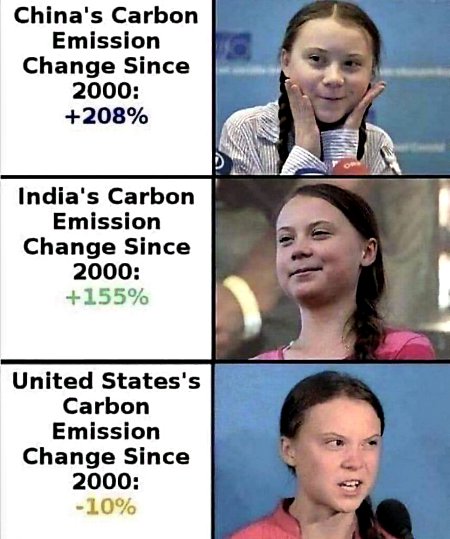
Greta Thunberg, the severely mentally ill spokestroll for the world’s Global Warmists, is the perfect face for the hypocrisy and selective actions of the Warmists as a whole. Only certain countries are faced with their outrage and have to deal with Leftist politicians pandering to them. Other, somehow always non-White, countries can, do, and will act and “pollute” as the please with no reasonable fear of backlash.
Then, the entirety of the AGW alarmism and activism has almost always been more about wealth redistribution and equity than it’s been about Climate Change. And it’s been far more about padding the pockets of a small number of businessmen and politicians than that.
This entry was posted on Tuesday, April 23rd, 2024 at 7:31 am and is filed under Humor, Politics, Society.
You can skip to the end and leave a response. Pinging is currently not allowed.
Announcement
Due to issues between the latest version of WordPress and my gallery plugin, galleries are currently broken. As a workaround, right-click gallery thumbnails and choose Open in New Tab or New Window.
 jonolan on Disney’s Indy Moments: “True! Though I don’t really understand why. They’re ruining their brand and their bottom line.” Aug 30, 07:36