It is self-evident that no number of men, by conspiring, and calling themselves a government, can acquire any rights whatever over other men, or other men’s property, which they had not before, as individuals. And whenever any number of men, calling themselves a government, do anything to another man, or to his property, which they had no right to do as individuals, they thereby declare themselves trespassers, robbers, or murderers, according to the nature of their acts.
— Lysander Spooner
Recent Comments
jonolan on Disney’s Indy Moments: “True! Though I don’t really understand why. They’re ruining their brand and their bottom line.” Aug 30, 07:36
typing learn on Trump Won: “getting the popular vote too is a massive shift.” Aug 26, 15:09
robber run on A Fine Irish Meal: “if the potatoes aren’t cooked three different ways then what’s the point” Aug 24, 22:17
Mikko Rantalainen on A Monument To Gen Z: “The official name of this artwork is “Journey of Self Discovery” but I agree that “Monument to the new generation”…” Jul 2, 07:45
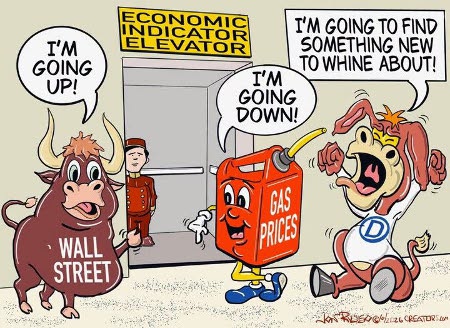
When it comes to economics, especially macroeconomic indicators, the only two things one can safely predict are that there will be ups and downs, and that the Democrats will whine about it either way because President Trump is commanding the nation.
Always remember, Democrats will always blame a contracting economy on Americans, especially President Trump these days. And, when the economy is growing, they will say, as loudly and harshly as possible, that this is just Trump making money for his “billionaire Cronies.” 🙄
This entry was posted on Sunday, June 28th, 2026 at 9:11 am and is filed under Humor, Politics.
You can skip to the end and leave a response. Pinging is currently not allowed.
Yep! Ole’ Ebenezer Schumer had some pointed humbugs about President Trump’s optimistic and reality-based praise of America’s improving economy. But, this means little and is to be fully expected. Nothing maddens a Democrat more than America recovering and doing better. It completely undermines their political platform and harms their ability to keep their jobs… and access to inside info on the stock market.
This entry was posted on Sunday, December 21st, 2025 at 9:21 am and is filed under Humor, Politics.
You can skip to the end and leave a response. Pinging is currently not allowed.
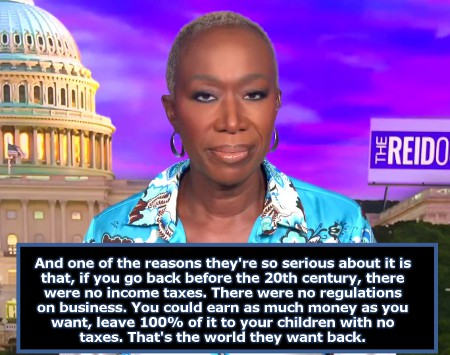
Fairly recently during an interview with BET, Joy Reid warned her Black viewers with a surfeit of anger, horror, and outrage that “people on the right” – that’d be true-born and rightly-raised Americans – want to “go back” to when there was no income tax and no regulations upon business, to when Americans could earn as much many as we wanted and leave 100% to a children. Oh yeah! And we’re racist and White Supremacists for wanting that… or we want that because we’re racist and White Supremacists.
And, of course, she added in the Democrat shibboleth of President Trump and we, his 70+ million supporters, being Fascists. That’s, however, almost not noteworthy since Dems seem to be required by their dogma to call us Nazis and/or Fascists during every screed.
All that being said, she’s not entirely wrong. Most Americans would love to eliminate or greatly reduce federal income taxes. Many of us would similarly love to eliminate or reduce state income taxes. And, all of us who have children would absolutely love the total elimination of Inheritance Taxes so that we could, in fact, leave 100% of our wealth to our descendants.
Also, a majority of us realize that the elimination or significant reduction in income tax won’t eliminate our tax burdens as much as many – apparently, including Reid – might think. In all probability, income tax would be partially replaced by specific levies for specific purposes, e.g., roads, public services, and actual national defense. But, since such levies would need to be voted for, we would have a bit more say in how our tax monies were spent… like we used to before 1933.
Reid’s a bit off with her accusation that we want to return to the time when there were no restrictions on business. What most of us would love is a reduction in many business regulations, especially in all manufacturing sectors, a sanity check for those regulations, and the elimination of punitive regulations meant to stifle certain industries. Americans also want to end Regulatory Capture, which is partially responsible for the inconsistent and twisted set of regulations that our businesses are burdened with today.
In point of fact – yeah, not something that sits well with things like Reid – a majority of “people on the right” want more, stricter, and stronger regulations on the banking and finance industry, especially the Derivatives Market. The insanity that is the new Rent-Backed Securities (RBS) is something that we who understand such things even a little hate at least as much as the Democrats do.
So, for the most part, Reid is right. Americans want to return to a time when we weren’t taxed and regulated into economic mediocrity, and absolutely want to be able to leave all of our wealth to our children if we choose to do so, instead of the government seizing a portion of it when we die.
The fact that Reid felt the need to state this as a dire warning couched in racism and White Supremacy says a great deal more about her, her audience, and the Blacks than it does the American people.
This entry was posted on Sunday, October 5th, 2025 at 10:12 am and is filed under Politics, Society.
You can skip to the end and leave a response. Pinging is currently not allowed.
It’s Labor Day, but there’s not much celebrating… and even less Joy and Hope. Americans just aren’t doing very well, and they haven’t been since the Democrats’ coup removed President Trump from office and replaced him with Creepy Uncle Joe and Kamala “Hyena” Harris. Very much worse for Americans, Harris and Walz will most likely just make it worse if they’re allowed to claim victory in November.
This entry was posted on Monday, September 2nd, 2024 at 9:08 am and is filed under 2024 Elections, Politics.
You can skip to the end and leave a response. Pinging is currently not allowed.
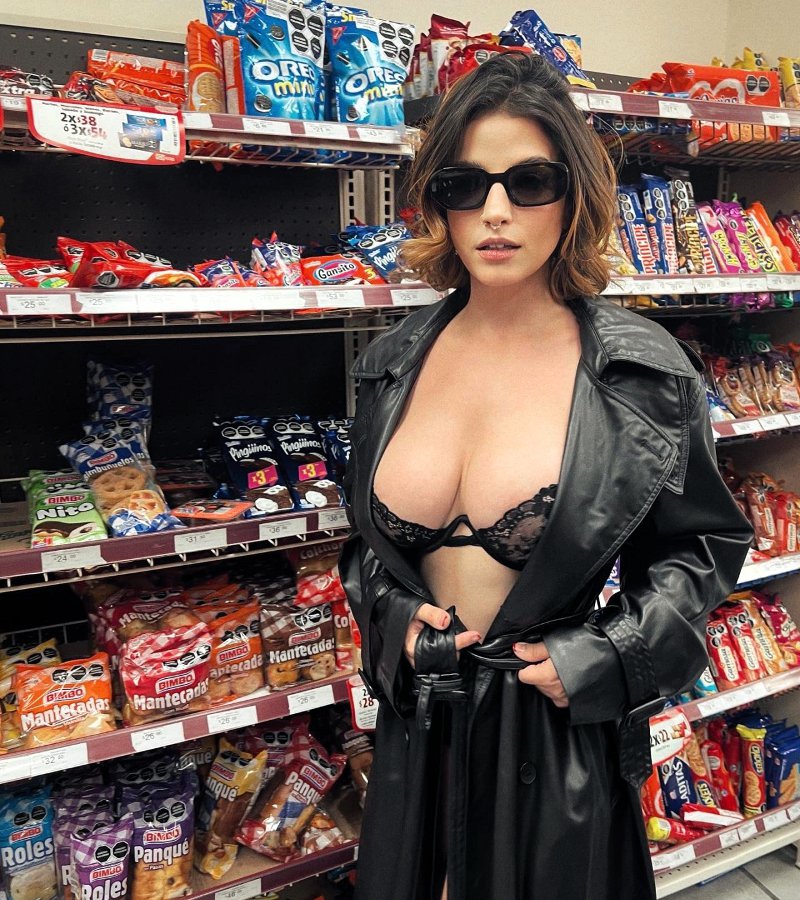
It has long been the case that many, if not most, photo shoots of beautiful women are in exotic, expensive locations. They’ve always been selling the dream of the whole lifestyle, not just the women. These days since Biden was installed as POTUS, this has become somewhat disturbing. More and more these days, I’m finding the expensive location being the grocery store!
Yeah, starting about mid June, 2021, hot babes in scanty clothing in grocery stores started getting more and more common. And, I say that is a nonstandard but on-the-ground accurate economic indicator. Worse, it’s an indicator that our economy – that of the normal American – is in collapse.
And please, my fellow Americans, understand that it will only get worse if Harris is installed into office. What passes for its economic policy is even worse than Biden’s. And that’s not even counting the chilling effect that Harris would have upon the American economy.
This entry was posted on Thursday, August 8th, 2024 at 9:06 am and is filed under 2020 Elections, 2024 Elections, Humor, Politics, Society.
You can skip to the end and leave a response. Pinging is currently not allowed.
Announcement
Due to issues between the latest version of WordPress and my gallery plugin, galleries are currently broken. As a workaround, right-click gallery thumbnails and choose Open in New Tab or New Window.
 jonolan on Disney’s Indy Moments: “True! Though I don’t really understand why. They’re ruining their brand and their bottom line.” Aug 30, 07:36