Are we at last brought to such an humiliating and debasing degradation that we cannot be trusted with arms for our own defense? Where is the difference between having our arms under our own possession and under our own direction, and having them under the management of Congress? If our defense be the real object of having those arms, in whose hands can they be trusted with more propriety, or equal safety to us, as in our own hands?
— Patrick Henry
Recent Comments
jonolan on Disney’s Indy Moments: “True! Though I don’t really understand why. They’re ruining their brand and their bottom line.” Aug 30, 07:36
typing learn on Trump Won: “getting the popular vote too is a massive shift.” Aug 26, 15:09
robber run on A Fine Irish Meal: “if the potatoes aren’t cooked three different ways then what’s the point” Aug 24, 22:17
Mikko Rantalainen on A Monument To Gen Z: “The official name of this artwork is “Journey of Self Discovery” but I agree that “Monument to the new generation”…” Jul 2, 07:45
Freedom is freedom, after all. Hence, if we are forced to allow filth to desecrate our flag and/or the flags of our allies, burning the Hamas flag must be A-OK too. That just makes sense. You can’t have laws protecting some but not others, right?
Wrong, at least functionally wrong for the average American citizen. While various ever-so-educated legal pundits and scholars will claim from the rarefied safety, comfort, and isolation of their ivory towers that, in the absence of other factors, these are each protected acts of symbolic free speech, on the ground this isn’t the truth at all. In any Leftist controlled zone – geopolitical or digital – there are almost always those other factors. And, few if any normal Americans have the means or wherewithal to contest either the State or the platform when they are imprisoned or otherwise censored.
I mean, sure, if you burn the Hamas flag at home where nobody can see you do it, you’re “protected.” But, if you burn it where the things support Hamas can see it, you’re likely to be arrested, suspended from school, and/ or deplatformed. Conversely, they can do pretty much whatever they desire and the police will protect them, even up to using lethal force against you if you try to stop them.
This entry was posted on Sunday, December 3rd, 2023 at 11:00 am and is filed under Politics, Society.
You can skip to the end and leave a response. Pinging is currently not allowed.
It’s a sad thing, but this is how the queer freaks and their nigh on mindless enablers really think and how they want to react and act in response the the SCOTUS’ opinion upon Creative LLC v. Elenis.
They truly believe that the SCOTUS has decreed that businesses can refuse to serve people et al simply because they some form of minority, in this case LGBT+ sorts. And, of course, they’re hysterical over it and indulging in masturbatory fantasies about refuse to service various, more normative Americans.
But… like with almost every erosion of special privilege that any minority group faces, both their complaints and fantasies are just wrong and based upon their own ignorance and demands for special treatment.
The SCOTUS’ opinion upon Creative LLC v. Elenis in no way, shape, or form – not even by implication or “penumbra” – say that any business may refuse customers who possess some specially protected trait, e.g., being non-White, non-Christian, or Queer. Indeed, the Court’s opinion is predicated upon the owner of 303 Creative LLC, Lorie Smith’s uncontested assertion that she is “willing to work with all people regardless of classifications such as race, creed, sexual orientation, and gender,” and she “will gladly create custom graphics and websites” for clients of any sexual orientation.”
No. The Court’s ruling is that the State cannot compel expression – read as Speech – that goes against one’s religious views. Hence, they cannot compel Creative LLC to make a wedding website for a queer couple, but they could penalize them for simple refusing to provide their services to Queers just for being queer. Similarly, a Muslim-owned company could not be compelled by the state to provide creative/expressive services for a bar mitzvah or bat mitzvah. One could, thanks to this ruling even refuse to provide such services for #BlackLivesMatter and/or #MAGA events, if one decide that either or both groups espoused behavior that goes against one’s firmly held beliefs.
But, what’s both sad and casus belli is that these freaks don’t make a distinction between what they want to do and what they are. If people will not support any and every one their actions, they see it as a direct attack upon their very identity and existence. And, they want to create a world where everyone is compelled to do so.
This entry was posted on Monday, July 3rd, 2023 at 11:00 am and is filed under Politics, Religion, Society.
You can skip to the end and leave a response. Pinging is currently not allowed.
As with all regulatory agencies when left unchecked, the FDA causes great harm through its hyper-authoritarian stances and rules as well as preventing harm through other rules. It’s why such agencies, operating outside of legislation but having the force of law, need to be regularly checked and forced to defend their actions by properly elected officials.
A perfect case in point is the FDA’s lethal regulations that categorically and absolutely forbid drug manufacturers engaging in any form of speech which can be construed as describing or promoting a use of their drug(s) for any use other than an the FDA approved on-label use, even if the information about this other use is entirely truthful, totally non-misleading, and could help physicians better treat their patients.
As a result of the FDA’s interpretation of the Federal Food, Drug and Cosmetic Act (FDCA), manufacturers of pharmaceuticals may face severe penalties for disseminating truthful and non-misleading information about off-label uses before those uses are approved by the FDA. Indeed, some companies have paid settlements of hundreds of millions or billions of dollars in the face of threatened prosecution or trial in civil false claims cases. Governments and other private actors do not suffer the same burdens on their speech, even though the pharmaceutical manufacturer likely has the most complete, up-to-date, and useful information about the product. Moreover, even when it makes economic sense for a pharmaceutical manufacturer to seek FDA approval for a new use, the FDA can take many months or even years to approve such new uses. Patients — especially those with life-threatening conditions — cannot wait for the agency to act. Even with recent changes in the FDCA, if a new use concerns a rare disease — or the drug is off-patent — it may not be economical for the pharmaceutical manufacturer to seek approval of a new use.
And, sadly, this is lethal regulatory intransigence and tyranny. It has killed, is killing, and will continue to kill people. And all for no valid purposes other than keeping the manufacturers of pharmaceuticals on their proverbial knees before the Deep State and maintaining the perceived relevance – and budget appropriations – of the FDA.
With the FDA censoring what drug makers can publish – even when it’s true, simply presented, and efficacious – many doctors aren’t able to know that there are alternative, off-label, treatment options available for their patients. Similarly, this censorship makes it functionally and legally impossible for health insurance providers to cover the costs of those prescriptions. That has, can, and will kill people – all for the sake of the powermongers of the FDA.
This seems to be no longer be true, but in my day, if you wanted to try CHANTIX to aid you in stopping smoking, insurance wouldn’t cover it because it was an off-label use of the medication.
And, if we’re to even begin to believe the current, #Woke sorts, this is systemic racism since non-Whites, especially the Blacks, are less likely to be able to afford medications that aren’t covered by health insurance. Hence, they’re “disproportionately impacted” by the FDA’s lethal regulations upon free speech involving medicines’ uses.
Honestly, American or Democrat, everyone should be calling for a end to the FDA’s lethal regulation and censorship and calling upon the organization to account for and defend its regulations – which aren’t laws but carry the weight thereof without Legislative oversight – or be forced to abandon them.
This entry was posted on Saturday, November 26th, 2022 at 5:30 am and is filed under Politics, Society.
You can skip to the end and leave a response. Pinging is currently not allowed.
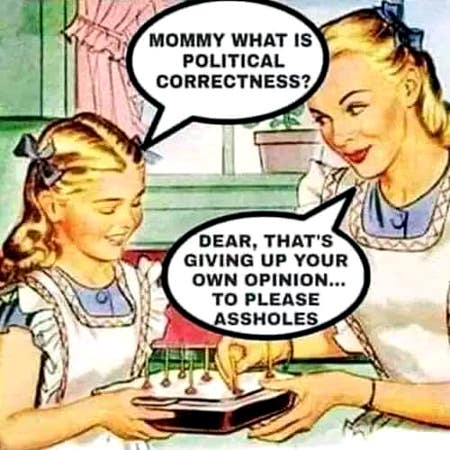
There’s a lot of specific ways to phrase this truth, but the one above is as good as any of them. Political Correctness is giving up you own opinion to please assholes or, at least, censoring what you say or do in order to propitiate them.
This entry was posted on Wednesday, October 26th, 2022 at 9:00 am and is filed under Announcements.
You can skip to the end and leave a response. Pinging is currently not allowed.
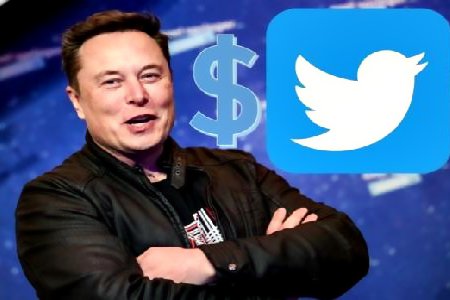
Yesterday, April 25, 2022, Multi-billionaire and the richest single individual in the world, Elon Musk outright purchased Twitter for roughly $44 billion. When your net worth is $264.6 billion USD, you get to do that, and the Democrats’ government can’t do much about it and is unlikely to even try. 😉
Twitter As We Know It Is Over… Maybe
So, if Elon Musk does all, most, or even a significant fraction of what he claims his plans are for renewing and rebirthing Twitter – and, since he’s taking it private, there’s nothing stopping him from doing so – the Twitter that we either love or loath is likely over.
Free speech is the bedrock of a functioning democracy, and Twitter is the digital town square where matters vital to the future of humanity are debated. I also want to make Twitter better than ever by enhancing the product with new features, making the algorithms open source to increase trust, defeating the spam bots, and authenticating all humans. Twitter has tremendous potential – I look forward to working with the company and the community of users to unlock it.
Read Musk’s statement very carefully. Three words in the 1st sentence of it are very, very important, and firmly grounded in US case law. Those words are, “digital town square.”
As I’ve written before, the SCOTUS has already ruled twice that social media platforms are the modern age’s public or town square and are, as such, bound by the restrictions of the 1st Amendment.
Social media allows users to gain access to information and communicate with one another on any subject that might come to mind. With one broad stroke, North Carolina bars access to what for many are the principal sources for knowing current events, checking ads for employment, speaking and listening in the modern public square, and otherwise exploring the vast realms of human thought and knowledge. Foreclosing access to social media altogether thus prevents users from engaging in the legitimate exercise of First Amendment rights.
So, Twitter is now poised to be transformed into an actual platform for the free exercise of speech… if Mr. Musk actually follows through on his pledge. And truly, the only real thing that could prevent him from doing that is if the market will not bear it and Twitter’s federally limited number of stockholders find this too painful to tolerate. That seems more than little unlikely given people’s addiction to social media in general and Twitter in specific.
Now, it’s true that word of Musk’s now essentially fulfilled intent to buy Twitter spurred certain sorts of users, including some high-profile ones, to “say” #GoodByeTwitter, we’ve all seen, heard, and/or read about that sort of promised exodus before. 😉 So I doubt there will be much in the way of financial fallout from the buyout and proposed changes.
So, the ball is in Elon Musk’s court. Elon Musk’s new platform will largely be whatever he wants it to be. He owns it after all. I’ve some hope for it, but that hope is seasoned by long experience.
This entry was posted on Tuesday, April 26th, 2022 at 10:10 am and is filed under Society.
You can skip to the end and leave a response. Pinging is currently not allowed.
Announcement
Due to issues between the latest version of WordPress and my gallery plugin, galleries are currently broken. As a workaround, right-click gallery thumbnails and choose Open in New Tab or New Window.
 jonolan on Disney’s Indy Moments: “True! Though I don’t really understand why. They’re ruining their brand and their bottom line.” Aug 30, 07:36


 This seems to be no longer be true, but in my day, if you wanted to try CHANTIX to aid you in stopping smoking, insurance wouldn’t cover it because it was an off-label use of the medication.