Mikko Rantalainen on A Monument To Gen Z: “The official name of this artwork is “Journey of Self Discovery” but I agree that “Monument to the new generation”…” Jul 2, 07:45
jonolan on New Client, New Problem: “😆 I’m always going to advocate for both. It be too hypocritical for me to do otherwise.” Sep 21, 07:03
Tyler, the Portly Politico on New Client, New Problem: “My top two from this exquisite collection: 1.) https://i0.wp.com/blog.jonolan.net/wp-content/uploads/sites/1/nggallery/need-new-shirts/08.jpg?ssl=1 2.) https://i0.wp.com/blog.jonolan.net/wp-content/uploads/sites/1/nggallery/need-new-shirts/12.jpg?ssl=1 I can’t figure out the winner! Tuscan bouffant or…” Sep 20, 18:59
Ummm… yeah. Hegel’s Angels – that’d be some seriously hardcore philosophy. Then, Hegelianism is always pretty damn hardcore. And yes, as I write this I’m thinking about a bunch of serios bikers “debating” the specifics of Entwicklung as it applies to whatever they’re about to do. 😛
Yeah no. I, for one, would much rather reach a mutually satisfying arrangement with my demons. I mean, aside from the obvious benefits of doing so, they’ve always been there for me, even when everyone else left.
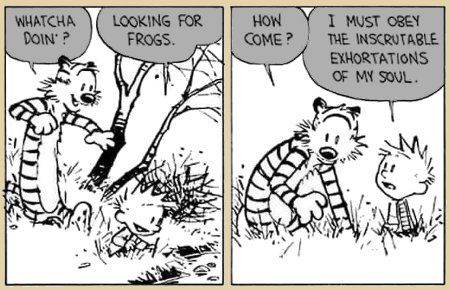
Bill Watterson’s Calvin and Hobbes has always been a source of rare and somewhat underrecognized wisdom. This quick cartoon is a perfect example of the subtle lessons Mr. Watterson taught. I would call it a lesson in Adulting Childhood or Childing Adulthood.
Perhaps we as a culture were and are too fond of and yet, at the same time, to ignorant of the meaning in 1 Corinthians 13:11. Perhaps we, to our harm, put away the childlike alongside the childish. We seem to listen to our minds while ignoring our hearts’ and souls’ exhortations to find and appreciate the wonders big and small that abound in Creation.
If you’re my age, near to it, or older than me – though I can’t vouch for the younger sorts – you’ve had some exposure to the tale of Icarus and his father, Daedalus. And, we’ve always had taught to us a cautionary tale against hubris or excessive ambition – essentially a fable of what dire consequences come from not knowing your place and acting above your station or means.
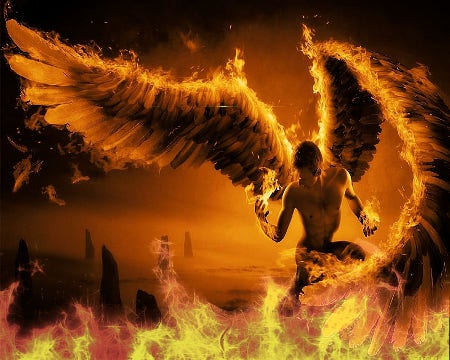
But what then if Icarus laughed as he burned and fell?
Yes, what if Icarus laughed through his pain as he burned and fell? That would change the tenor and the moral of this ancient fable.
There is a bitter triumph in crashing when you should be soaring
And isn’t there such a bitter triumph? To fly in the face of greater powers; to force them to recognize your existence; to feel their wrath upon your flesh, knowing that those powers can wrack and ruin your flesh, end your body’s life, but cannot quell your soul. That is triumph, albeit a bitter one. That is a death well-earned and rarely equaled.
There is a certain beauty in setting the world on fire and watching from the centre of the flames
And yes! I’m honest enough to admit – indeed, to proclaim – that there is a certain beauty in destruction and that the best and greatest view of it if from the epicenter of the flames.
Then Let Us Burn Together
So not what Ovid’s work was meant to teach, but truer to the spirit of Man. What greater and more terrible beauty can there be than scream out our spite till the flames melt our lungs and burn out our voices? What more awesome beauty is there for any of to see than world burning around us until it melts the eyes from our faces?
It is hard to deny the beauty and majesty of not just refusing to go quietly into the long night; not just raging raging against its coming – but laughing as we bring the light of our pyre into it.
Due to issues between the latest version of WordPress and my gallery plugin, galleries are currently broken. As a workaround, right-click gallery thumbnails and choose Open in New Tab or New Window.
 Mikko Rantalainen on A Monument To Gen Z: “The official name of this artwork is “Journey of Self Discovery” but I agree that “Monument to the new generation”…” Jul 2, 07:45